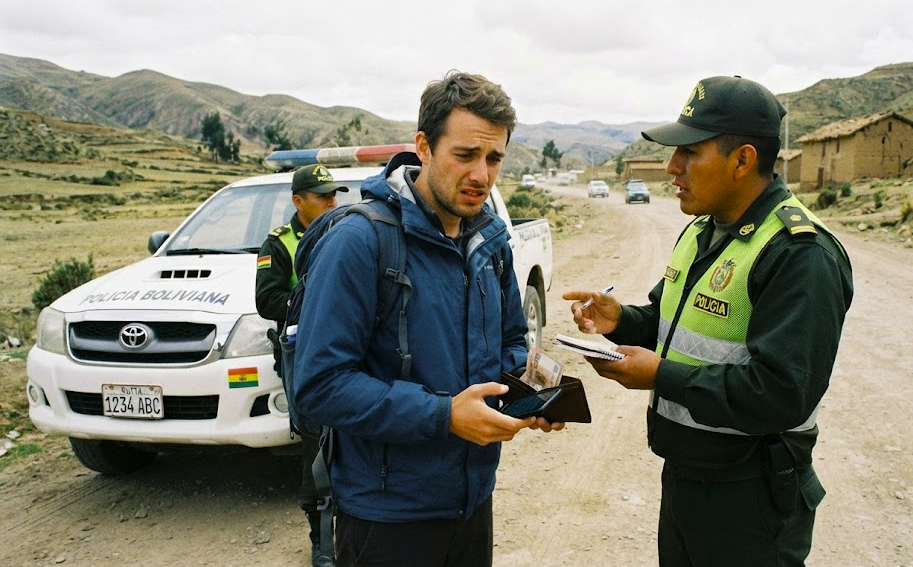
After 13 years of traveling alone across North America, Europe, Southeast Asia, and Latin America without losing anything, one traveler finally got robbed in Santa Cruz, Bolivia. The trap was simple: two men posing as police officers, a fake document check, a short car ride, and just enough pressure to make a seasoned traveler ignore his own instincts.
The damage was more than $500 in cash and a Google Pixel 8a. The more important lesson was what happened in the minutes before those things disappeared.
- The Reality: A person showing a badge and claiming to be undercover police does not automatically make a roadside encounter legitimate.
- The Ground Risk: The biggest mistake was getting into an unmarked car and allowing strangers to move him and his belongings away from a public location.
- The Traveler's Hack: Stay in a public place, verify the officers independently, photograph identifying details when safe, and never let strangers control your bag or phone.
The Bolivia Police Scam Started Like an Ordinary ID Check
It was around noon.
That detail matters because nothing about the scene looked like the stereotypical setup for a robbery. It wasn't a dark alley. It wasn't the middle of the night. The traveler wasn't drunk, distracted by a nightclub, or wandering around with his guard down.
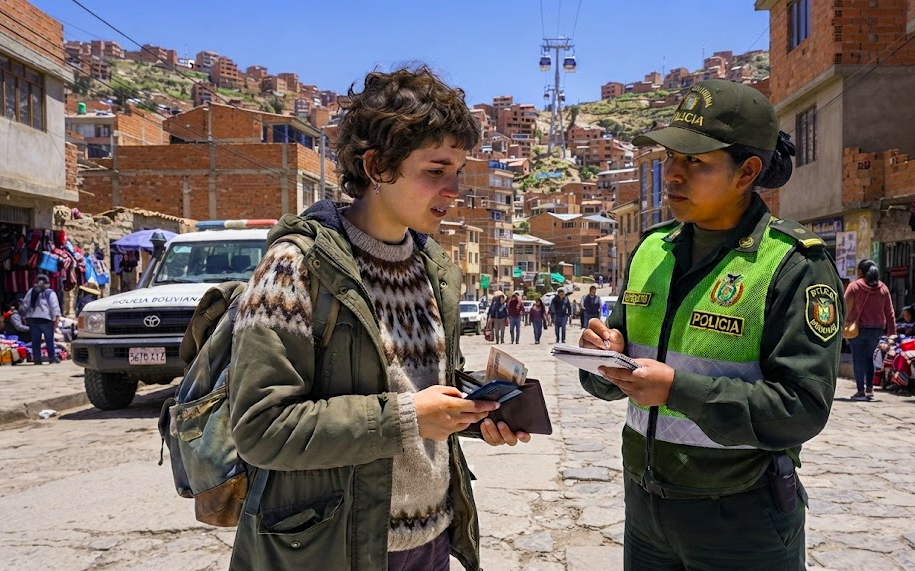
He was standing outside his Airbnb building in Santa Cruz with his luggage, getting ready to check in.
Then a man in his 50s approached him.
The man introduced himself as an undercover police officer and flashed what appeared to be identification with a police badge. He said he was checking foreigners' immigration status and making sure they weren't involved in narcotics trafficking.
That was enough to change the entire psychological equation.
A stranger asking to see your passport is suspicious.
A stranger claiming to be police asking for your passport is something else entirely.
The traveler had doubts, but his instinct was shaped by growing up in the West, where ignoring someone who appears to be a police officer can create its own problems. Spanish also wasn't his first language, which made the situation harder to interpret in real time.
Then came another detail that made the story seem more legitimate.
The alleged officer stopped another man who appeared to be Ecuadorian and asked him for identification too.
Looking back, the traveler believes the second man was part of the setup.
At the time, however, he looked like another foreigner being checked.
That was the trick.
The situation wasn't presented as one stranger versus one traveler. It was presented as an official procedure happening to multiple people.
The Moment the Red Flags Became Impossible to Ignore
The supposed officer said they needed to go somewhere else to check their information.
The traveler thought he meant a police station.
Then he noticed the car.
It wasn't a marked police vehicle.
He asked about it.
The explanation was that they were undercover.
That answer should have ended the interaction.
Instead, the traveler got into the car.
This was the turning point.
Once he was sitting inside an unfamiliar vehicle with his belongings separated from him, the balance of control had completely changed.
The men drove several blocks while continuing to ask questions about his business in Bolivia. Eventually, they stopped and began searching his backpack.
They said they were looking for drugs.
They even talked about detecting the smell of marijuana.
Then the questions became more invasive.
How much cash did he have?
What else was he carrying?
What was the PIN to his phone?
They claimed they needed to check the device for pornography and evidence of involvement in narcotics trafficking.
At this point, the traveler knew something felt wrong.
But he was already inside the car.
His belongings were in the trunk.
And he didn't know whether refusing to cooperate with someone claiming to be an undercover officer might make the situation more dangerous.
That uncertainty is what makes this scam particularly uncomfortable.
There was no obvious knife.
No gun was displayed.
No one immediately threatened him.
Instead, the scammers built a situation where the victim had to make a high-stakes decision with incomplete information.
And they kept giving him just enough reassurance to continue.
The Backpack Trick Was Hiding in Plain Sight
One of the most important details came later.
The men appeared to put his belongings back into his backpack.
He actually watched them do it.
That made him believe everything was still there.
But they wouldn't let him close the backpack himself.
They insisted on doing it.
When they handed it back, they also didn't let him inspect it properly before leaving the vehicle.
Those details only became obvious after the fact.
At the time, they were small oddities buried underneath the larger story about immigration checks, drug searches and undercover police work.
This is how a convincing scam can work.
The individual actions don't necessarily scream robbery.
They create a sequence that makes the victim keep rationalizing the next step.
Unmarked car? Undercover operation.
Another foreigner being questioned? Seems legitimate.
Searching the backpack? Maybe police procedure.
Asking for a phone PIN? Strange, but maybe legal.
Closing the backpack themselves? Probably nothing.
Until suddenly you're standing on the sidewalk with an empty pocket.
Then He Opened the Backpack
The car drove away.
The traveler immediately opened his backpack.
His phone was gone.
So was more than $500 in cash.
That was the moment the entire story snapped into focus.
He hadn't been taken to a police station.
He had been taken for a ride.
And by the time he understood what had happened, the car was already gone.
There was no license plate recorded. No useful photograph. No chance to confront the men.
Just an empty space where his phone and cash had been.
The stolen phone was replaceable.
The cash was replaceable.
The frightening part was realizing how easily the situation could have gone in another direction.
The traveler himself put it bluntly: once he was inside that car, he was in a vulnerable position. He believes that cooperating may have helped prevent the encounter from escalating further.
That's an important distinction.
Travel safety advice often gets written as if every dangerous situation has one perfect move.
Real life doesn't work that neatly.
Sometimes you recognize a scam early.
Sometimes you realize it three steps too late.
And sometimes the safest decision after making a bad decision is simply to avoid escalating the situation.
What the Traveler Would Do Differently Now
The biggest lesson wasn't "carry less cash."
It wasn't "learn more Spanish."
It wasn't even "don't trust undercover police."
It was much simpler:
Don't get into the car.
The traveler said he should have told them to continue the conversation inside the Airbnb lobby.
If they wanted to inspect his belongings, they could do it somewhere public.
If they wanted him to go to a police station, he could have asked for an official police vehicle.
If he wasn't sure who they were, he could have contacted the actual police or asked the Airbnb building staff to verify the situation.
The key is keeping control of the location.
Once you're inside someone else's vehicle, you've surrendered far more than your personal space.
You've surrendered your ability to simply walk away.
A Camera Could Have Changed the Equation
The traveler also believes he could have photographed the men and their vehicle before getting in.
Interestingly, he even asked the alleged officer if he could take a photo with him.
The man said yes.
But the photo never happened.
In hindsight, that moment stands out because a genuine request to document an official encounter would at least have created another opportunity to slow everything down and verify what was happening.
A photograph could also potentially have captured the vehicle or license plate.
That doesn't mean travelers should aggressively photograph suspicious people in every confrontation.
The priority is personal safety.
But when an encounter feels wrong, creating distance, moving toward other people, and documenting identifying details from a safe position can be valuable.
The Cash Problem Was a Lesson Too
The traveler had been carrying substantial emergency cash for years.
There was a practical reason.
When you travel long-term, cash can solve problems cards can't.
An ATM can be broken.
A bus might accept only cash.
A phone can disappear.
A card can stop working.
An airport currency exchange might be your only option at the wrong moment.
But after years of carrying that emergency stash, he realized he had barely needed most of it.
In this case, more than $500 was physically accessible to the people who robbed him.
About $175 of that was also in currencies from other countries he had previously visited.
His revised thinking was much simpler: carry enough emergency cash to solve a genuine problem, but not enough to turn a street robbery into a major financial loss.
| Travel Safety Factor | What Happened | Lower-Exposure Approach |
|---|---|---|
| Cash | More than $500 carried together | Keep a smaller emergency amount accessible |
| Police vehicle | Unmarked private car | Ask for verification or an official vehicle |
| Location | Left the Airbnb area | Stay inside a lobby or other public place |
| Belongings | Backpack controlled by strangers | Keep your bag with you and inspect it yourself |
| Phone access | PIN requested during the search | Don't surrender device access without independently verifying the authority |
| Identification | Badge appeared convincing | Verify identity independently before moving anywhere |
The Backup Phone Turned a Bad Day Into a Manageable One
This is where the story takes a surprising turn.
The traveler had prepared for exactly the kind of digital disaster that most people don't think about until their phone disappears.
He had a backup phone.
Both devices were configured with Google's Find Hub so the stolen phone could be remotely locked and tracked.
More importantly, sensitive applications were protected by fingerprint authentication using AppLock.
Financial apps.
Email.
Notes.
VoIP.
Even settings.
That extra layer mattered because stealing a phone is one problem.
Stealing a phone that is already connected to your email, banking, authentication systems and personal information is a much bigger one.
Once back at the Airbnb, he pulled out his backup phone and immediately marked the stolen device as lost through Find Hub.
He also canceled the credit card that had been on the stolen phone and reported the theft to police.
The thieves got the hardware.
They didn't get the whole digital life attached to it.
The Backup Phone Wasn't the Only Smart Move
Another surprisingly useful part of the setup was his VoIP phone number.
Because his primary number was through Fongo, he could log into the VoIP app on the backup phone and regain access to the number.
That helped him receive the two-factor authentication codes needed to restore WhatsApp and other accounts.
It is the sort of boring travel preparation nobody thinks about when everything is working.
Until the phone is suddenly gone.
Then it becomes the difference between a frustrating afternoon and a full-blown account-recovery nightmare.
The Four Layers That Limited the Damage
His preparation effectively created several separate barriers:
- Backup phone — gave him another device immediately.
- Find Hub — allowed him to lock and locate the missing phone.
- Fingerprint-protected apps — added another barrier around sensitive information.
- VoIP number — allowed him to recover his primary number and receive authentication codes.
None of those measures prevented the robbery.
They limited what happened afterward.
That's an important distinction.
Travel security isn't about creating a magical system where nothing bad can happen.
It's about making sure one bad event doesn't cascade into five more.
The Part He Got Lucky With
There is no sugarcoating the situation.
He made a serious mistake by getting into the car.
But the outcome could have been dramatically worse.
The men didn't physically harm him.
They didn't take his laptop.
They didn't take all of his belongings.
They didn't appear to access his financial accounts.
And his backup phone remained hidden in another compartment of his backpack.
He later reported the theft to the police, who told him they were investigating and waiting on CCTV footage. They also showed him photographs of a similar-looking vehicle and possible perpetrators.
Whether that investigation eventually identifies the people involved is another story.
For the traveler, the immediate priority was much simpler.
He was safe.
The laptop was safe.
His important accounts were protected.
And he had learned a scam he had never encountered in 13 years of solo travel.
The Real Lesson Isn't "Never Trust Anyone"
That would be too easy.
Travelers interact with strangers constantly.
You need locals for directions. You need taxi drivers. You need hotel staff. You need border officials. Sometimes you genuinely do encounter police officers who are simply doing their jobs.
The more useful rule is this:
Don't let someone else's claimed authority override your ability to verify what is happening.
A badge can look convincing.
A confident voice can sound official.
A second person can make a fake situation feel real.
A story about drugs or immigration can make you feel like refusing is dangerous.
And once you're sitting inside someone else's car, your options become much narrower.
The traveler didn't fall for an obviously ridiculous story.
He fell for a carefully staged situation that exploited something most people are trained to respect: authority.
That's why this story is worth remembering.
Not because every stranger is dangerous.
Not because every police interaction abroad is suspicious.
But because when something feels wrong, you are allowed to slow the situation down.
Stay somewhere public.
Ask for identification.
Verify independently.
Ask for an official vehicle.
Call your accommodation.
Contact the actual police.
Keep your belongings in your possession.
And if someone wants to move you somewhere else, that's the moment to stop and think.
The best travel safety trick isn't paranoia.
It's keeping enough control over the situation that you still have choices.
Have you ever been approached by someone pretending to be police while traveling? What was the red flag that finally gave them away — or did you realize it only afterward? Share your story in the comments below.
🛡️ DAYLL Editorial Transparency
This post was researched and synthesized by the Dayll consumer editorial team. We test, verify, and cross-reference public policies and insider tips to bring you actionable advice without sponsor influence.